


6 key benefits of CI/CD
CASENINE SPOTLIGHT SERIES In conversation with: Joris Bruijn, DevOps Manager at CaseNine Have you heard of Continuous Integration and Continuous Deployment…
Key Points
- Most revenue leakage isn't visible on a dashboard. It's hidden in price discounts, out-of-control automation, and manual reconciliation.
- A targeted diagnosis can determine in minutes what an internal audit often takes weeks to determine.
- A free check is a good start, but most people stop at the configuration and don't get to the revenue stream itself.
- The right approach depends on the complexity: a light review for a simple environment, and more in-depth engineering for a layered one.
- Ask for a report that outlines priorities, not a general checklist.
Brief Assessment
For most teams, a targeted assessment like Revenue at Risk is the quickest way to get started: it’s free, takes about ten minutes, and doesn’t require access to your systems. Save a full discovery for organizations with years of accumulated complexity.
CASENINE SPOTLIGHT SERIES
In conversation with: Joris Bruijn, DevOps Manager at CaseNine
Have you heard of Continuous Integration and Continuous Deployment, or CI/CD for short? This way of working for development teams, thanks to a good amount of automation, improves the quality of projects and makes the process less prone to errors. Joris Bruijn quickly updates you on the benefits of CI/CD.
Starting at the beginning: what does CI/CD mean?
"CI/CD is short for Continuous Integration and Continuous Deployment. It is a method where development teams use automation to execute steps. CI/CD works well when different people and teams work together and need to align processes well. Teams work together more efficiently as a result. At CaseNine, CI/CD is used extensively."
Less error prone
"CI/CD has major implications for development processes, which benefit customers directly. Smart automation - for example, in handling code changes - makes the process less error-prone. In addition, the speed of the development process improves. Tests take place continuously - during development - and no longer have to be scheduled afterwards and separately. Finally, CI/CD also helps with quality control: you discover errors at an early stage."
The 6 key benefits of CI/CD
CI/CD:
- Automates the deployment part
- Standardizes whenever possible: this reduces the likelihood of errors
- Provides automatic roll-back
- Let developers develop faster
- Lends itself well to team collaboration
- Eliminates the need to test code separately
Writing your own unit tests
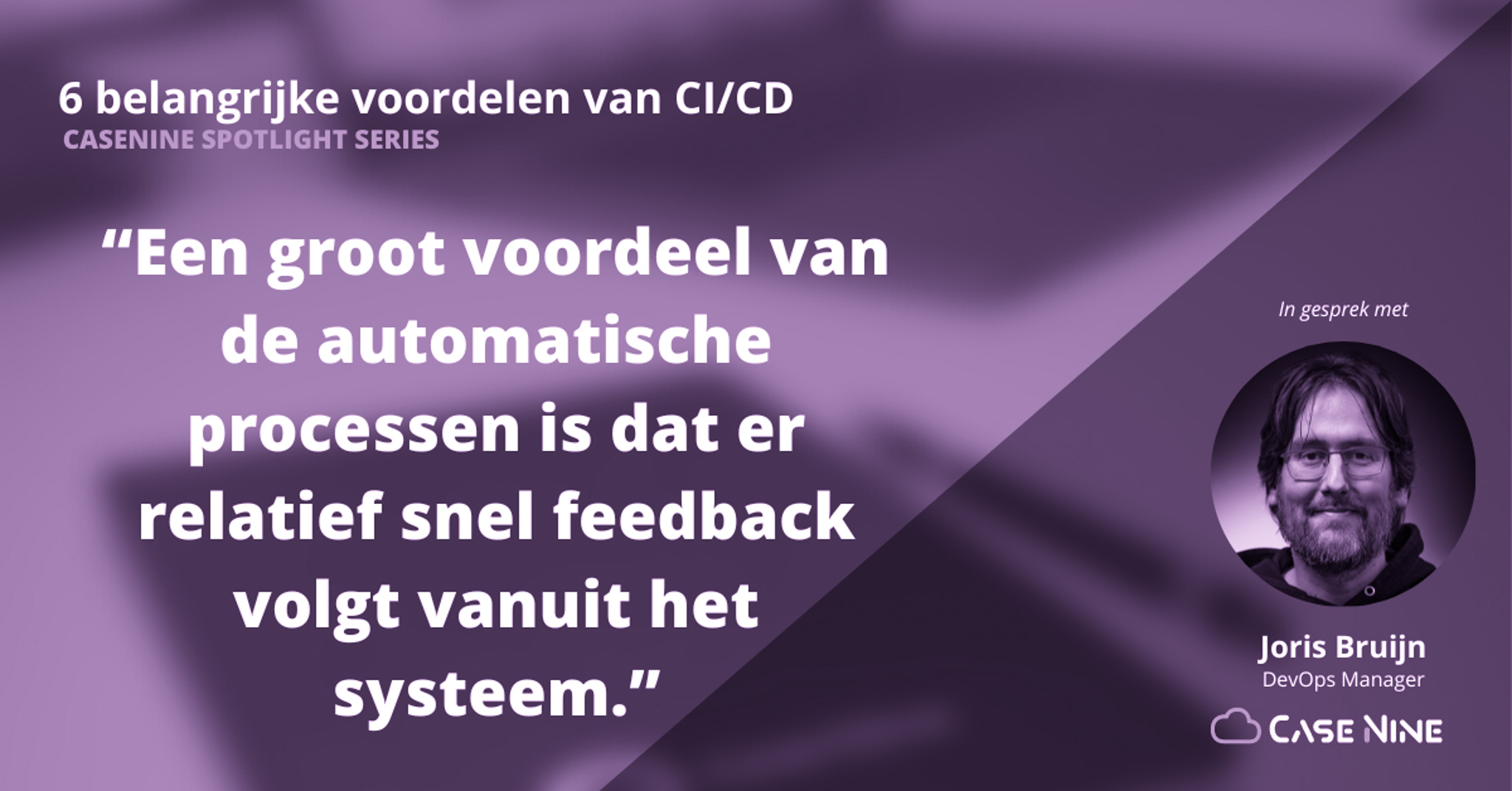
"For developers, CI/CD also has several advantages and implications. A major advantage of the automatic processes is that feedback follows relatively quickly from the system. This has a positive effect on overall quality: feedback is used at an early stage for further improvement. Developers now have the ability to write their own unit tests. So here at CaseNine, they also learn to write this test and directly write code that improves functionality. By the way, this is not new to us: we have been working this way for about 6 years now."
What can developers consider?
"Writing a good test is an important foundation and often the most difficult part of the whole thing. Once you've invested in a good test, it pays off. Good test code quickly reveals errors. In practice, CI/CD is appreciated by developers and works extremely well. You no longer need to know how to deploy: after all, deployment also takes place automatically."
What should an organization consider?
"For CI/CD, you need additional infrastructure to host the CI/CD pipeline on (e.g. Teamcity, Azure/Bitbucket pipelines). It also needs to be set up properly once. This can sometimes be complex. This investment in money and time always pays off quickly because less time needs to be spent on testing and deploying afterwards: a recurring task at every sprint."

Yannick van Eldik
CaseNine Yannick van Eldik is a co-founder of CaseNine and helps organizations increase their revenue by optimizing commercial processes.
Share this article
Read more
Related insights

Technical Deepdive Series
Scalable Salesforce integrations for steady growth
This article explains why Salesforce integrations become unstable over time and how you can design scalable, reliable architecture using a diagnostic, targeted approach.
April 11, 2026 · 3-minute read
Read more
Technical Deepdive Series
Seamless Salesforce Integration: A Practical Guide to Sustainable Growth
This article explains why Salesforce integrations become unstable over time and how you can restore predictable behavior through clear architectural choices, data ownership, and error handling.
April 10, 2026 · 4-minute read
Read more
Technical Deepdive Series
AI-powered testing in Salesforce sales processes
This article demonstrates how AI-powered testing improves stability in complex Salesforce revenue processes through better diagnostics, regression testing, and robust governance.
April 9, 2026 · 3-minute read
Read moreFind the leak before it finds your margin
Revenue at Risk is free, takes about ten minutes, and doesn't require access to your systems. You'll receive a clear report with priorities, reviewed by an engineer—never by a chatbot.